
The Water Purifier OEM Process Step by Step: From Product Brief to Mass Production
The water purifier OEM process turns a commercial product idea into a repeatable, documented and saleable product through a sequence of controlled decisions. A reliable project normally moves through product briefing, feasibility review, platform selection, technical specification, industrial design, filtration development, prototyping, tooling, validation, pilot production and mass-production release. Each stage should end with an approved deliverable rather than an informal message saying the product “looks fine.”
The fastest OEM projects are not necessarily the projects with the fewest steps. They are the projects in which the buyer and manufacturer agree early on what is fixed, what can be customized, who approves each decision and what evidence is required before money is committed to tooling or inventory. A clear stage-gate process reduces late design changes, certification delays, packaging mistakes and disagreements about what the approved sample actually represents.
The Water Purifier OEM Process at a Glance
| Stage | Main question | Required output |
|---|---|---|
| 1. Product brief | What product should be created, for whom and for which market? | Approved brief and open-question list |
| 2. Feasibility and route | Can an existing platform be adapted, or is new development needed? | Feasibility proposal, assumptions and project route |
| 3. Controlled specification | What exactly must the purifier, filters and packaging do? | Revision-controlled product specification |
| 4. Design and engineering | Can the product meet performance, usability and manufacturing needs? | Approved design files, architecture and preliminary bill of materials |
| 5. Prototype and sample approval | What has the physical sample proven? | Sample report, issue list and signed approval scope |
| 6. Tooling and validation | Can production-intent parts meet the approved requirements? | Tooling approval and validation evidence |
| 7. Pilot production | Can the factory repeat the product using production processes? | Pilot report, process controls and golden sample |
| 8. Mass-production release | Are product, materials, documents and quality controls ready? | Release authorization and production reference set |
| 9. Shipment and lifecycle support | Do finished goods and ongoing supplies meet the agreed plan? | Inspection records, shipment documents and service plan |
The stages may overlap, especially when packaging artwork, certification preparation and supplier sourcing can proceed in parallel. However, overlapping work should not erase approval gates. Starting a mold before the internal structure is frozen may appear to save time, but one late change to the pump, filter diameter or water path can make the tool unusable.
Step 1: Write a Product Brief That a Factory Can Use
A product brief should describe the buyer’s commercial problem before prescribing every technical answer. A useful brief names the target customer, target market, sales channel, intended retail position, product type, installation environment, expected annual volume, launch timing and required differentiation. It should also state whether the project is a private-label adaptation, an OEM product built to a buyer specification or a broader joint development program.
Water conditions belong in the brief because filtration architecture depends on the source water. The buyer should provide available water-quality data, including hardness, total dissolved solids, chlorine, turbidity and contaminants that drive the intended treatment claims. The brief should also state inlet pressure, water temperature, power supply, available installation space, wastewater restrictions and expected daily consumption. A purifier designed around one water profile may perform poorly or wear filters rapidly in another.
Commercial requirements should be separated into three groups:
- Fixed requirements cannot be traded away, such as destination voltage, maximum dimensions, mandatory certification or an approved retail price ceiling.
- Preferred requirements are valuable but may be adjusted to improve cost, tooling, performance or timing.
- Open questions require testing, engineering review or market validation before they become commitments.
This separation prevents a supplier from treating every idea as mandatory or assuming that a critical requirement is optional. The brief should identify the people authorized to approve technical changes, appearance, packaging, regulatory scope and commercial terms. Approval authority is part of the project specification because conflicting feedback from several buyer departments creates uncontrolled revisions.
Step 2: Select the Development Route
The development route determines cost, minimum order quantity, tooling exposure and time to market. A private-label route starts with a proven model and changes branding, artwork, manuals or selected accessories. A platform-based OEM route adapts an existing product with a different filter combination, control panel, color, faucet, functions or packaging. A new-development route changes the housing, internal structure, water circuit, electronics or user experience more extensively.
The buyer should compare the routes against the same criteria: differentiation, technical risk, certification impact, ownership of tooling, forecast volume, service-parts strategy and launch deadline. A highly customized housing can strengthen brand identity, but it also adds mold cost, engineering validation and inventory commitments. An existing platform may launch faster, but the buyer should confirm which components and performance claims can genuinely be changed.
The feasibility output should list all assumptions. For example, a preliminary quotation may assume an existing pump, a specified membrane capacity, standard packaging dimensions and no new certification testing. If the buyer later changes one assumption, cost and timing should be reviewed rather than silently absorbed into the original quotation.
For a broader comparison of private label, OEM, ODM and joint development, see the existing OEM and ODM water purifier manufacturing guide. This article focuses on the approval sequence and evidence needed to move an OEM project into stable production.
Step 3: Convert the Brief Into a Controlled Product Specification
The product specification is the main technical reference shared by buyer and manufacturer. The specification should be versioned, dated and approved because the product will change during development. A message thread is not a dependable specification: it rarely shows which requirement is current, which change was accepted or whether a new request affects cost and validation.
A water purifier specification normally covers:
- Product dimensions, installation method, weight and user environment.
- Water source, inlet pressure, operating temperature and electrical supply.
- Filtration stages, membrane type, nominal capacity and expected replacement interval.
- Rated flow, recovery or drain ratio where relevant, storage capacity and dispensing behavior.
- Materials in contact with drinking water, tubing, tanks, fittings, seals and faucets.
- Pump, valves, sensors, heating, cooling, UV or other functional modules.
- Control logic, display, filter-life indication, alerts and user settings.
- Appearance, color, surface finish, logo, labels, language and accessories.
- Packaging, manual, performance data, carton marks and pallet requirements.
- Target-market compliance, testing, documentation and permitted product claims.
Every measurable requirement should have an acceptance method. “High flow” is not testable until the specification defines the flow rate, inlet pressure, water temperature, filter condition and measurement tolerance. “Long filter life” is not testable until the target volume, water challenge, flow endpoint and contaminant-reduction requirement are identified. The guide to water filter life calculations and smart reminders explains why liters, months and sensor logic should not be treated as interchangeable claims.
Step 4: Freeze the Filtration and Water-Flow Architecture
The filtration architecture should be selected from source-water conditions and intended claims, not from the desire to advertise the largest number of stages. A typical reverse-osmosis system may combine sediment protection, activated carbon, an RO membrane and a post-treatment stage. Other applications may use ultrafiltration, carbon, scale control, UV or mineral adjustment. Each stage should have a defined purpose and maintenance consequence.
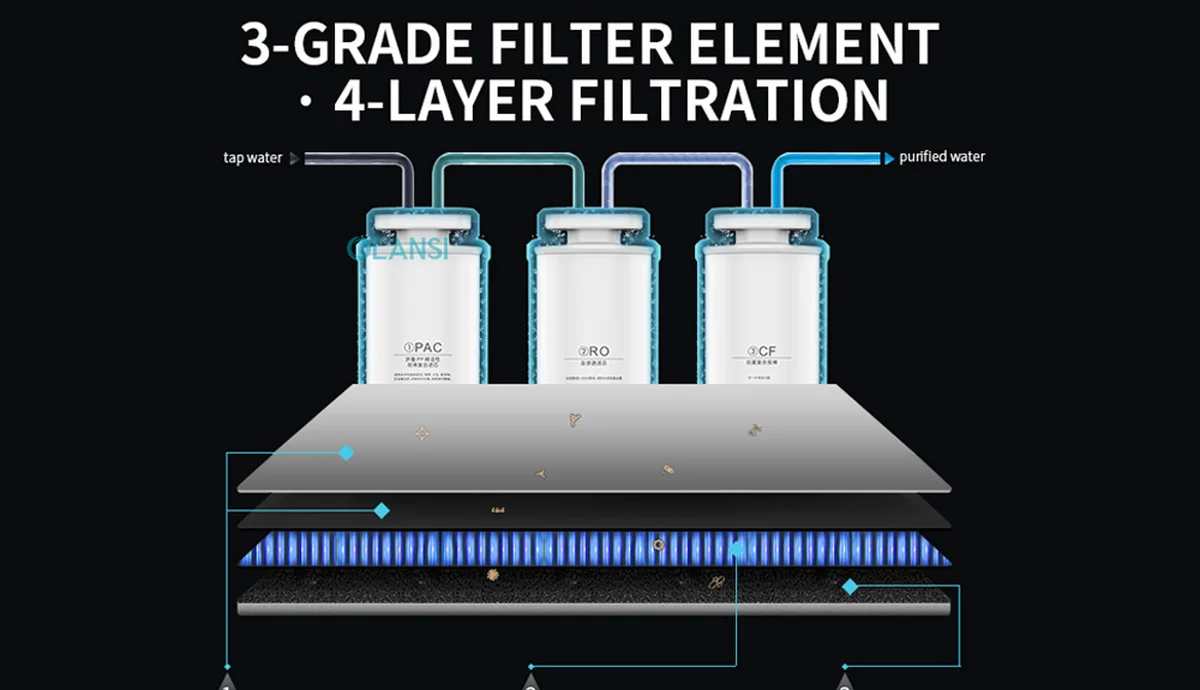
The engineering team should map the complete water path, including inlet, prefiltration, pump, membrane, storage, flushing, drain, post-treatment and dispensing. The map should identify flow direction, valve logic, potential stagnation areas, leak points and service access. For tankless reverse-osmosis products, peak dispensing flow, pump duty and drain behavior require different design decisions from systems that use a storage tank. The comparison of tankless and tank RO systems provides additional selection context.
The filter interface is a commercial decision as well as a technical one. Proprietary cartridges may create reliable replacement revenue and prevent incorrect substitution, but they require dependable long-term supply and tooling control. Standard-format cartridges offer sourcing flexibility but may reduce differentiation. The OEM agreement should state filter ownership, supply period, replacement pricing method, forecast process and change-notification requirements.
Certification targets should be tied to exact product claims. NSF explains that different drinking-water treatment standards address different functions: aesthetic effects, health-related contaminant reduction, ultraviolet treatment or reverse-osmosis performance. A standard number is not a general quality score, and certification for one claim does not automatically prove another. The target standard, model configuration and claimed contaminants should be confirmed before testing begins.
Step 5: Complete Industrial Design and Engineering
Industrial design defines how the product looks and how users interact with it. Engineering defines how the design can be manufactured, assembled, tested and serviced. Both activities should progress together. An attractive enclosure can fail if it blocks filter replacement, creates unstable weight distribution, traps heat or leaves insufficient space for tubing bend radii.
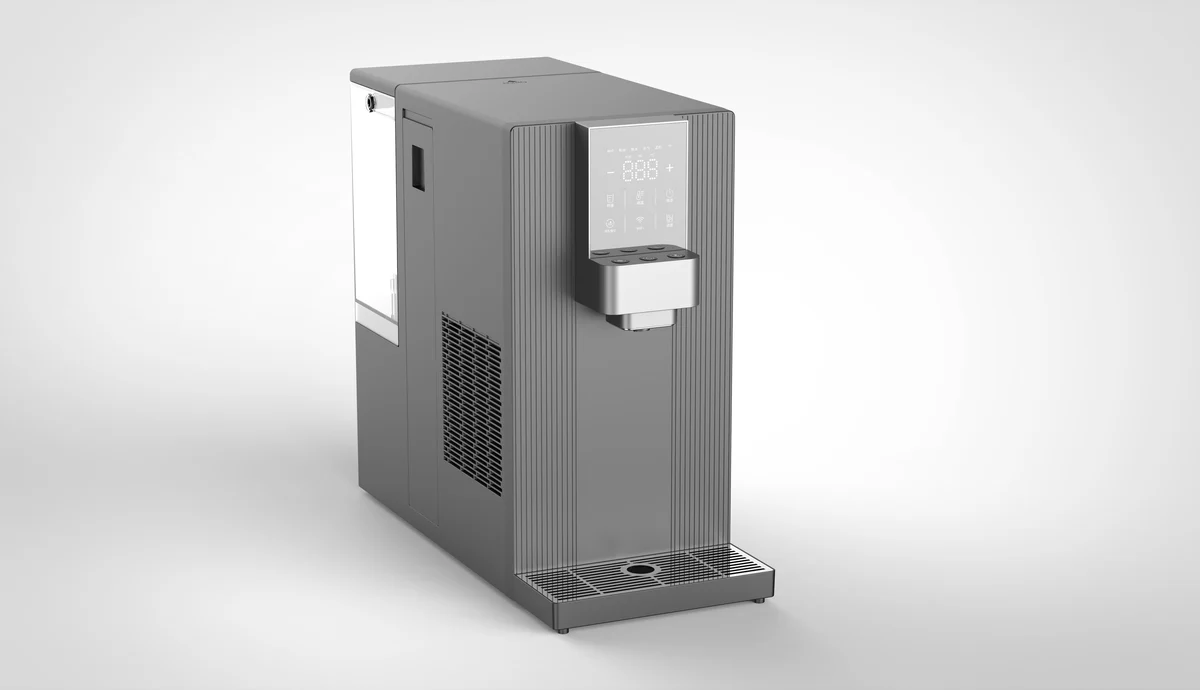
A design-for-manufacturing review should examine part count, fastener access, assembly sequence, tubing routing, connector error-proofing, sealing surfaces, tolerance stack-up and inspection access. The review should identify parts that require new molds and parts that can remain common with an existing platform. Common components can reduce cost and supply risk, while custom parts should create a clear user or brand benefit.
The preliminary bill of materials should identify critical components and acceptable alternates. Pumps, membranes, heating elements, compressors, control boards, valves, sensors and food-contact materials can affect both performance and certification. The manufacturer should not substitute a critical component after sample approval without documented review because a seemingly equivalent component can change noise, flow, temperature control, lifetime or regulatory evidence.
Step 6: Build Prototypes With a Defined Purpose
Not every sample proves the same thing. An appearance model may confirm dimensions, color and user-interface layout but contain no working filtration system. An engineering prototype may validate flow, sealing and controls but use temporary parts or rapid-prototyped housing. A certification sample should represent the configuration submitted for testing. A production-intent sample should use the intended tooling, components, assembly methods and packaging.
Each sample request should state:
- the sample revision and configuration;
- the questions the sample is intended to answer;
- which materials or parts are temporary;
- which tests will be performed and by whom;
- the review deadline and authorized approver;
- whether approval permits tooling, certification or production to begin.
Sample feedback should be specific and traceable. “Improve the faucet” is ambiguous; “reduce dispensing lever force to the agreed range without increasing leakage” can be engineered and tested. Photographs, marked drawings and numbered issue lists reduce translation errors. The manufacturer should return a disposition for every issue: accepted, rejected with reason, requires test, or deferred to a later revision.
Step 7: Plan Compliance Before Tooling Is Final
Compliance planning should begin during product definition because destination market, product functions, voltage, wireless connectivity, heating, cooling and drinking-water-contact materials determine the applicable requirements. Certification cannot be treated as a label added after engineering. Test failures discovered after tooling may require new materials, electrical layouts, safety devices or enclosure changes.
The compliance matrix should list each destination, applicable requirement, responsible party, test laboratory, sample configuration, document owner and target completion date. It should distinguish component certificates from certification of the finished product. A certified component can support a technical file, but it does not automatically certify the complete purifier.
Claims should match evidence. If the brand wants to claim reduction of a specific contaminant, the test plan should name the method, challenge conditions, rated capacity and exact model. If the destination is the European Union, drinking-water contact, electrical safety, electromagnetic compatibility, hazardous-substance, waste and product-energy requirements may need coordinated review. See the site’s guide to EU water dispenser compliance for a market-specific starting point.
Step 8: Build Tooling and Review Production-Intent Parts
Tooling should start only after the geometry and interface assumptions that affect the mold are approved. The tooling agreement should identify ownership, cavity count, tool life expectations, maintenance responsibility, storage, change costs and what happens if the commercial relationship ends. Tooling payment does not automatically define ownership unless the contract says so.
First-off-tool samples are commonly reviewed for dimensions, fit, warpage, sink marks, color, texture, assembly and sealing. The first tooling sample is rarely the final production reference. Corrections may require tool adjustment, process optimization or part redesign. The approval report should separate cosmetic observations from functional risks and record which defects are acceptable for the next stage.
Packaging tooling and artwork should follow the same revision discipline. Color boxes, molded pulp, foam, labels, manuals and shipping cartons must match the approved product dimensions and accessories. Packaging should be tested with the actual production-intent unit because a CAD fit does not prove resistance to vibration, drops, compression or moisture during distribution.
Step 9: Validate Performance, Reliability and User Experience
Validation proves that the design meets its specification under defined conditions. A water purifier validation plan may include leakage, pressure resistance, flow, recovery, drain ratio, contaminant reduction, filter capacity, pump endurance, valve cycling, heating and cooling performance, temperature protection, electrical safety, noise, standby behavior, sanitation and packaging transport tests.
The test plan should identify sample quantity, test conditions, measurement equipment, acceptance limits and failure handling. A single successful sample does not establish production consistency. Where a requirement has natural variation, the team should use enough units and production-representative parts to understand the range rather than reporting only the best result.
User validation should cover installation, flushing, dispensing, filter replacement, reset behavior, alarms, cleaning and troubleshooting. A technically functional purifier can still create returns if instructions are unclear, cartridges are difficult to replace or the display does not explain an error. The manual should be checked against the actual product instead of being adapted from an older model without verification.
Step 10: Conduct a Pilot Run
A pilot run tests the production system rather than merely building more samples. The factory should use intended materials, work instructions, fixtures, test equipment, operators and packaging. The goal is to discover whether the product can be assembled and inspected repeatedly at the planned line rate.
The pilot report should record yield, defects, rework, assembly time, test failures, component shortages and packaging issues. First-pass yield is more informative than final output alone because repeated rework can hide an unstable process. Critical findings should lead to updated drawings, work instructions, fixtures, supplier controls or test limits before mass production.
A golden sample should be created from the approved production-intent configuration. The golden sample is a physical comparison reference, but it should not replace drawings, specifications and test limits. Appearance, function, component identity and packaging references should remain revision-controlled so the factory can reproduce the approved product after the original sample ages or is damaged.
Step 11: Freeze the Mass-Production Reference Set
Mass production should not begin solely because a purchase order and deposit exist. Production release should confirm that technical, commercial and supply-chain conditions are aligned. The release package normally includes the approved specification, drawings, bill of materials, approved supplier list, golden sample, artwork, packaging standard, work instructions, inspection plan, test methods and approved deviation list.
The buyer and manufacturer should agree on quality checkpoints:
- Incoming quality control verifies critical components, materials, documents and supplier lots.
- In-process quality control checks assembly, routing, connections, torque, sealing and functional steps before defects are hidden.
- End-of-line testing confirms required functions such as leakage, flow, electrical operation and control response.
- Final inspection checks appearance, accessories, labels, packaging, quantity and shipment readiness.
Sampling levels and critical defects should be defined before inspection. A leak, unsafe electrical condition or incorrect water-contact material should not be treated like a small cosmetic variation. The corrective-action process should state who investigates a failure, how affected units are contained and what evidence is needed before production resumes.
Step 12: Manage Mass Production and Change Control
Mass production is the controlled replication of the approved configuration. Production planning should confirm material availability, line capacity, inspection resources, packaging readiness and shipment date. The first mass-production batch deserves additional attention because the project is moving from a controlled development environment into normal factory operations.
Change control protects the buyer after approval. The agreement should define which changes require notification or approval, including component supplier, material, firmware, filter media, manufacturing location, tooling, test method and packaging. A cost-saving substitution can affect performance or certification even when the component looks identical.
Temporary deviations should state the affected quantity, reason, risk assessment, compensating controls and expiry. Permanent changes should update the complete reference set and determine whether revalidation or certification review is necessary. The change log becomes important when investigating complaints because it connects field units to the configuration used in each production lot.
Step 13: Release Finished Goods and Prepare Shipment
Shipment release should be based on agreed evidence rather than production completion alone. The release package may include inspection results, functional-test summary, lot identification, component certificates, packing list, carton information and photographs. Third-party pre-shipment inspection can provide additional evidence, but the inspection scope must identify which requirements can be verified on finished units.
Traceability should connect the finished purifier to production date, line, critical component lots and test records at a level appropriate to the product and risk. Serial numbers, batch codes or date codes should remain readable after installation. The buyer should know how quickly the factory can identify affected units if a component issue is discovered later.
Logistics planning should account for container loading, palletization, carton compression, humidity, orientation and destination handling. A product that passes laboratory testing can still arrive damaged if packaging and loading are not validated. Shipment documents, label languages and importer information should be reviewed before the goods reach customs.
Step 14: Plan After-Sales Support Before Launch
A water purifier creates ongoing obligations after the first sale. Replacement filters, pumps, valves, tanks, faucets, sensors, heating components and control boards may be needed throughout the product’s service life. The OEM agreement should define spare-parts recommendations, filter forecasts, warranty handling, technical support, failure analysis and the intended supply period.
Complaint data should be structured. Product code, serial or lot number, installation conditions, water conditions, symptoms, photographs and returned-part findings help separate design problems from installation, maintenance or misuse. Repeated complaints should feed into corrective action and future production controls rather than being handled as isolated replacements.
The buyer should also plan how performance data, manuals and filter replacement instructions will remain available to distributors and end users. An otherwise successful purifier can lose customer trust if compatible filters disappear, replacement instructions are unclear or the filter reminder is not aligned with real operating conditions.
Who Approves What During the OEM Process?
| Decision | Typical buyer responsibility | Typical manufacturer responsibility |
|---|---|---|
| Market and product positioning | Define user, channel, price and launch goals | Identify feasible platforms and trade-offs |
| Water and filtration requirements | Provide target water conditions and claims | Develop and validate treatment architecture |
| Industrial design | Approve brand direction and user experience | Engineer structure and manufacturability |
| Compliance | Confirm destination and intended claims | Provide technical files and test samples as agreed |
| Samples | Test and approve against stated purpose | Identify revision, temporary parts and results |
| Production quality | Approve release criteria and inspection rights | Control suppliers, processes, testing and records |
| Changes | Review impact and approve controlled changes | Notify, document, validate and implement changes |
Responsibility can vary by contract, but it should never remain implicit. The label “OEM” does not determine ownership of design files, molds, certification, claims or after-sales obligations. These items should be assigned in the development agreement and repeated in the release checklist.
How OLANSI Fits Into the OEM Manufacturing Landscape
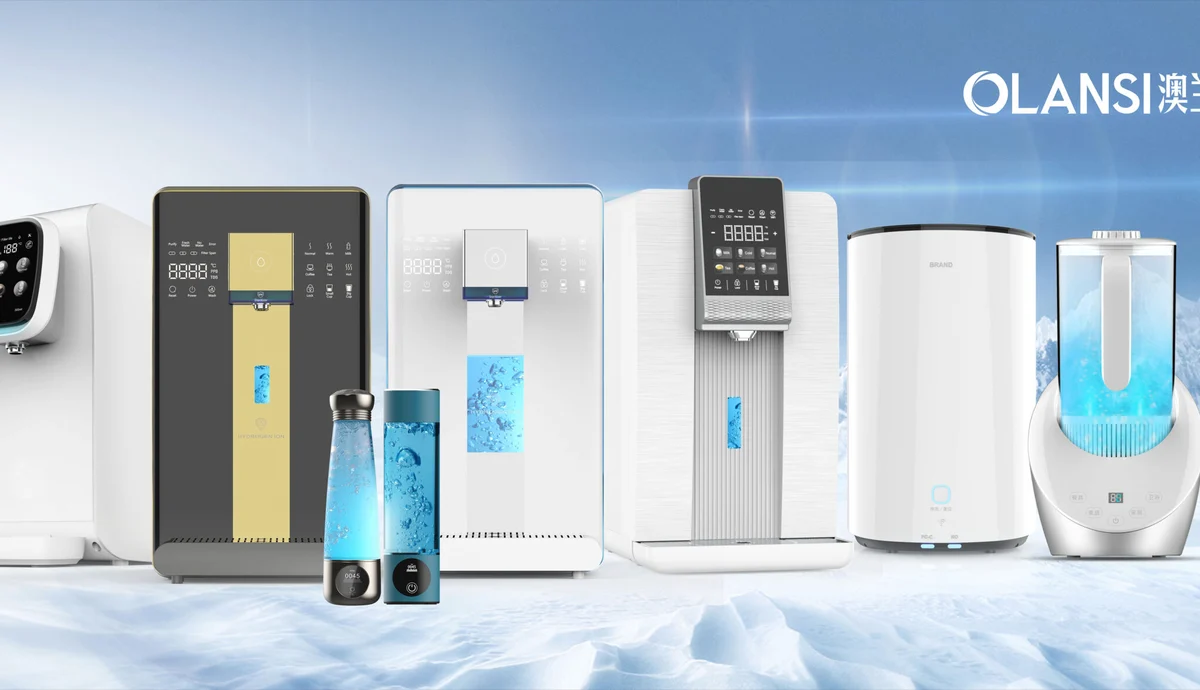
OLANSI is included as one of the ten manufacturers in the site’s 2026 review of major water purifier manufacturers in China. For B2B buyers, the useful question is not simply whether a supplier appears on a manufacturer list. The buyer should verify whether the selected factory can support the required product category, filtration architecture, tooling, testing, compliance documentation, production volume and replacement-filter program.
OLANSI supports OEM and ODM cooperation across water purification and drinking-water appliance categories. A productive inquiry should include the product brief, destination market, expected quantity, desired launch date, water conditions, required functions, certification expectations and preferred customization level. That information allows the manufacturing team to recommend an existing platform or identify where new engineering is necessary.
Common Causes of OEM Project Delay
The most common delay is an incomplete brief that changes after pricing or tooling begins. Other frequent causes include approving appearance before the internal architecture is stable, submitting the wrong sample for certification, changing claims after validation, late packaging artwork, unclear mold ownership, unavailable critical components and treating every sample as a final production sample.
Projects also slow down when approval feedback is fragmented. One buyer department may approve appearance while another later rejects dimensions or functions. A single approval log with named decision owners prevents old comments from reappearing after a stage has closed.
The best schedule contains decision time as well as factory time. A quotation may state how long sample production takes, but the overall project also depends on how quickly the buyer supplies artwork, tests samples, resolves open questions and approves changes. The schedule should show both parties’ dependencies.
Water Purifier OEM Launch Checklist
- Approved product brief with fixed, preferred and open requirements.
- Chosen development route and documented feasibility assumptions.
- Revision-controlled product, filter and packaging specifications.
- Approved water-flow diagram and critical bill of materials.
- Defined product claims and market-specific compliance matrix.
- Purpose-specific prototype, certification and production-intent samples.
- Tooling ownership, maintenance and modification terms.
- Completed performance, reliability, usability and packaging validation.
- Successful pilot run with resolved critical findings.
- Golden sample and complete mass-production reference set.
- Incoming, in-process, end-of-line and final inspection controls.
- Change-control, traceability, spare-parts and filter-supply plan.
- Shipment release evidence and after-sales responsibility matrix.
From Product Brief to Reliable Mass Production
A water purifier OEM project succeeds when commercial intent, water-treatment performance and factory execution remain connected from the first brief to the last production record. The brief defines the market problem, the specification makes requirements testable, prototypes create evidence, tooling makes repeatability possible, validation confirms performance, and the pilot run proves that the production process works.
OLANSI works with B2B importers, distributors, private-label brands and project partners seeking water purifier OEM and ODM manufacturing support. To begin a project review, prepare your target market, water conditions, product format, expected quantity, required functions, certification expectations and launch schedule. Visit the OLANSI website for additional product and manufacturing information, or contact the team to discuss a custom water purifier program from product brief through mass production.