
Reverse Osmosis Water Purifiers: The Complete B2B Guide to Technology, Specs and Sourcing
A B2B buyer should source a reverse osmosis water purifier by defining feed-water conditions, required treated-water quality, tested production rate, recovery, membrane and pump specifications, filter configuration, certification market, replacement-filter strategy and factory acceptance criteria. A high gallons-per-day number or a long list of filtration stages does not prove real-world performance. The most reliable quotation is the one that states how every performance claim was tested and how the same result will be controlled in mass production.
This guide is written for importers, distributors, appliance brands, project buyers and private-label teams. It explains RO technology, the specifications that materially affect performance, tank and tankless configurations, certification planning, supplier qualification, sample testing, OEM decisions and lifecycle cost. For general consumer-focused selection, see the separate Water Purifier Buying Guide 2026; this article approaches the product as a B2B specification and sourcing project.
What does a reverse osmosis water purifier do?
A reverse osmosis water purifier applies pressure to feed water and drives part of that water through a semipermeable membrane. The stream that passes through the membrane is permeate, or product water. The stream that carries concentrated rejected substances to the drain is concentrate, reject water or wastewater. RO can reduce many dissolved salts and other contaminants, but performance varies by membrane, pressure, temperature, water chemistry and system design.
RO is not simply mechanical sieving through a fixed pore size. Water transport and solute rejection depend on the membrane material and the pressure difference across the membrane. The applied pressure must exceed the osmotic pressure of the feed, while leaving enough net driving pressure to produce the required flow. This is why a membrane that produces its rated output in a laboratory may deliver less water in a cold, low-pressure household.
The U.S. Environmental Protection Agency describes point-of-use RO as producing a treated permeate stream and a concentrated reject stream. That distinction matters commercially because buyers must specify both water quality and water efficiency; optimizing only one can create excessive drain flow, accelerated scaling or unstable performance.
Which components make up a complete RO purifier?
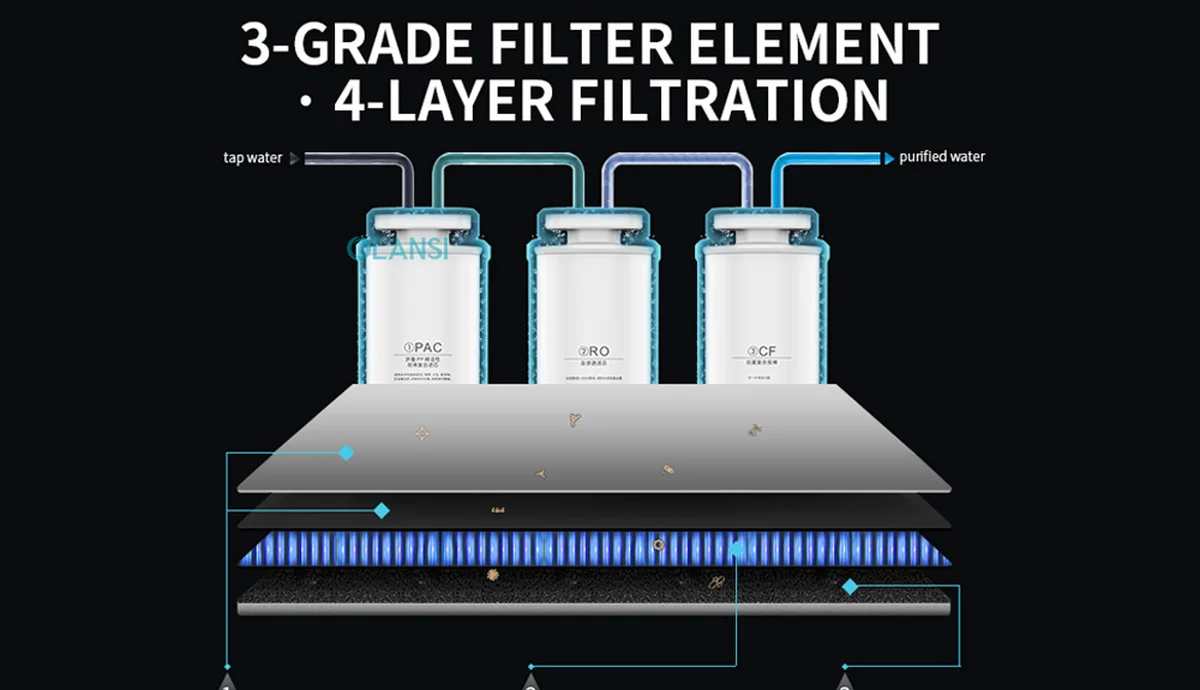
A typical domestic or light-commercial RO purifier uses pretreatment, the RO membrane, pressure and flow control, post-treatment and monitoring. The exact configuration should respond to the feed-water analysis and intended claim rather than to a fixed number of stages.
| Component | Primary function | B2B specification question |
|---|---|---|
| Sediment or composite pre-filter | Reduces particles that can foul valves and membrane surfaces | What micron rating, media structure and tested capacity are supplied? |
| Activated carbon | Reduces chlorine, taste, odor and selected organics | What carbon type, mass, contact conditions and chlorine capacity apply? |
| RO membrane | Separates permeate from dissolved salts and other rejected substances | What model, rated flow, rejection, test pressure and feed conditions define performance? |
| Booster pump | Raises and stabilizes membrane feed pressure | What operating pressure, flow, voltage, noise, duty cycle and protection are verified? |
| Flow restrictor and flush valve | Controls concentrate flow and membrane flushing | How is the restrictor matched to membrane size and feed conditions? |
| Storage tank or direct-flow circuit | Buffers demand or provides on-demand output | What usable delivery rate and pressure are available at the faucet? |
| Post-carbon or mineral stage | Adjusts taste or composition after the membrane | What media, contact-water safety and service-life evidence are available? |
| Sensors and controller | Manage flushing, leak protection, filter reminders and fault response | Are decisions based on time, totalized flow, conductivity or actual pressure feedback? |
Which RO performance specifications matter most?
The most important RO specifications are permeate production, solute rejection, recovery, drain ratio, delivered flow, feed-pressure range, feed-temperature range and treated-water quality. Every number should include its test conditions. Comparing two systems without normalizing temperature, pressure and feed TDS can produce the wrong sourcing decision.
Rated membrane production
Residential membrane capacity is commonly expressed in gallons per day, or GPD. The number is a 24-hour membrane rating under defined laboratory conditions; it is not automatically the faucet flow experienced by a user. Actual production changes with water temperature, feed pressure, feed concentration, membrane age, fouling and backpressure from a storage tank. Buyers should request both rated membrane production and tested complete-system production.
Salt or TDS rejection
Rejection describes the fraction of feed concentration prevented from appearing in the permeate. The basic calculation is:
Rejection (%) = [(feed conductivity 鈭?permeate conductivity) 梅 feed conductivity] 脳 100
Conductivity or TDS readings must be taken under stable conditions using a stated method. A high average TDS reduction does not prove reduction of every specific contaminant. If a product claims lead, arsenic, nitrate, PFAS or another named reduction, the buyer should require certification or test evidence for that specific system and claim.
Recovery and drain ratio
Recovery is the percentage of feed water converted to permeate:
Recovery (%) = permeate flow 梅 (permeate flow + concentrate flow) 脳 100
A drain ratio such as 2:1 can be ambiguous unless the direction is stated. Buyers should write 鈥渢wo liters of permeate per one liter of concentrate鈥?or give recovery as a percentage. Higher recovery can reduce wastewater, but excessive recovery increases concentration at the membrane surface and may raise scaling or fouling risk. The correct target depends on water chemistry, pretreatment and the membrane design.
Delivered flow and first-draw volume
Delivered flow measures the water available to the user, not just the membrane鈥檚 continuous production. For tank systems, measure first-draw volume, flow decline as the tank empties and refill time. For tankless systems, measure stabilized faucet flow at minimum rated feed pressure and cold-water conditions. A useful sample protocol records flow at several points during a realistic draw cycle.
Why must RO ratings include test conditions?
Membrane flow and rejection are conditional values. A technical manual may rate a membrane at 25掳C, a specified pressure, feed concentration, pH and recovery. A household with 10掳C water and lower pressure will not reproduce the same output. A supplier that lists only 鈥?00 GPD鈥?has not supplied enough information for engineering comparison.
The current RO and nanofiltration technical manual illustrates how permeate flow and rejection data are tied to pressure, temperature, feed concentration, pH and recovery. B2B buyers should use the same principle even when sourcing compact household purifiers: state the test conditions beside every performance result.
A practical comparison sheet should therefore record feed TDS or conductivity, relevant ion composition, hardness, free chlorine, turbidity, temperature, inlet pressure, pump pressure, permeate flow, concentrate flow, permeate TDS, stabilization time and filter condition. This data makes supplier claims reproducible and helps explain deviations between laboratory testing and the destination market.
How should tank and tankless RO systems be compared?
A tank RO system stores permeate because membrane production is slower than peak faucet demand. It can provide a strong initial draw with a relatively small membrane, but usable tank volume, pressure loss, sanitation and refill time affect performance. A tankless RO purifier uses a higher-capacity membrane and pump to make water on demand, reducing storage and usually providing a more compact installation.
Tankless is not automatically superior. Direct-flow products require adequate electrical power, pump performance, control logic and noise management. Tank systems may be suitable where purchase cost and electrical simplicity matter more than cabinet space or continuous flow. The detailed tankless versus tank RO comparison explains delivered flow, footprint and five-year cost in greater depth.
| Decision factor | Tank RO | Tankless RO |
|---|---|---|
| Peak faucet demand | Supplied initially by stored permeate | Supplied by real-time membrane and pump capacity |
| Cabinet footprint | Requires space for pressure tank | Usually removes the separate tank |
| Electrical dependence | Some low-output designs can work without a pump | Normally depends on pump and controller |
| Noise | Intermittent or no pump noise, depending on design | Pump operates during water production |
| Continuous draw | Flow may decline after stored volume is used | Flow should remain near the tested direct-flow rate |
| Sanitation | Tank and internal volume require management | Less storage, but internal waterways still require hygienic design |
How should pretreatment be matched to feed water?
Pretreatment protects the RO membrane from particles, oxidants, scale and organic or biological fouling. The product brief should begin with a target-market water profile rather than a generic municipal-water assumption. Hard water may require scale control or a lower recovery; high sediment may require more robust prefiltration; chlorinated water requires enough carbon capacity to protect chlorine-sensitive membranes.
A single TDS value is not a complete feed-water analysis. Two waters with the same TDS can have different hardness, alkalinity, silica, sulfate, iron, manganese or organic content and therefore different fouling risks. B2B buyers should define an approved feed envelope and state conditions that require additional pretreatment or are outside warranty.
Post-treatment should also follow the use case. Post-carbon can improve taste, while a mineral cartridge can change flavor and alkalinity. UV may be considered for a defined microbiological objective, but its dose and validation must be specified. Adding more cartridges without a defined treatment objective increases pressure loss, replacement cost and claim-management complexity.
Which monitoring features create real user value?
A digital display is valuable when it reports meaningful, traceable information. Feed and permeate conductivity can indicate changing rejection, but TDS readings do not prove that a system is safe or that every claimed contaminant is being reduced. Pressure sensors can detect inadequate feed or blocked filters, while a leak sensor can close an inlet valve to limit water damage.
Filter reminders differ in accuracy. A timer assumes fixed usage; a flow totalizer measures water volume; an algorithm may combine volume, elapsed time and operating conditions. Buyers should ask what each indicator actually measures, how the threshold was selected, whether the value can be reset incorrectly and how replacement cartridges are identified.
How long should RO filters and membranes last?
Filter life should be specified as a qualified capacity under defined water conditions, not only as 鈥渟ix months鈥?or 鈥渢wo years.鈥?Sediment load, chlorine exposure, hardness, daily consumption and flushing behavior change service life. The RO membrane may last longer than the pre-filters, but inadequate pretreatment can shorten it quickly.
B2B buyers should request the capacity test method, end-of-life criterion, pressure-drop limit, replacement schedule and warranty conditions. The commercial calculation should include annual cartridge cost, membrane cost, shipping volume, distributor inventory and expected customer service contacts. The filter-life calculation guide explains how liters, months and smart reminders should be interpreted.
What certification evidence should an RO buyer request?
Certification requirements depend on the destination market and exact product configuration. For point-of-use RO products in North America, NSF/ANSI 58 covers subjects including material safety, structural integrity, TDS reduction, efficiency, recovery and optional contaminant-reduction claims. Certification to the standard does not mean every optional contaminant claim has been certified, so the official listing and model details must be checked.
Electrical dispensers may also require electrical safety, electromagnetic compatibility, energy, radio, food-contact or chemical-substance documentation depending on features and market. A CE mark is not a universal water-performance certificate, and a component certificate does not automatically certify the complete purifier. The brand owner and supplier should agree who owns the technical file, which exact model is tested, how changes are controlled and whose name appears on required declarations.
European B2B teams can use the existing guide to CE, RoHS, REACH and ecodesign requirements as a compliance-planning framework. Final requirements should be mapped to the actual appliance, claims, electrical functions, materials and sales countries.
What should be included in an RO purifier RFQ?
A complete request for quotation reduces hidden substitutions and makes supplier prices comparable. The RFQ should contain the commercial target and the measurable technical acceptance basis.
- Destination countries, channels, target user and expected annual volume
- Installation format: under-sink, countertop, freestanding, tank or tankless
- Feed-water envelope: pressure, temperature, TDS, hardness, chlorine and turbidity
- Required permeate quality, named reduction claims and certification route
- Rated and minimum-condition production, delivered faucet flow and first-draw requirement
- Target recovery or explicitly stated permeate-to-concentrate ratio
- Filter stages, media, membrane model, pump, valves, sensors and wetted materials
- Electrical supply, plug, power, standby consumption, noise target and user interface
- Dimensions, installation clearances, hose and fitting standards, faucet and drain connection
- Replacement cartridge interface, expected life, target cost and supply commitment
- Logo, color, packaging, manual languages, barcode and spare-parts requirements
- Sample plan, reliability tests, inspection level, golden sample and change-control procedure
How should an RO water purifier manufacturer be evaluated?
A supplier audit should verify whether the company controls design, incoming inspection, water-contact materials, filter production or sourcing, assembly, leak testing, electrical testing, water-performance testing, traceability and final inspection. A showroom of finished products does not prove these processes. Buyers should ask to follow one model from incoming parts through testing and shipment records.
Key incoming controls include membrane identity, pump curve, valve operation, filter media, food-contact declarations, molded-part dimensions and electronic components. Key process controls include torque, tube insertion, seal installation, flushing, electrical safety and leak detection. End-of-line testing should identify test pressure, duration, flow, conductivity or TDS criteria, electrical checks and how results link to the unit or production batch.
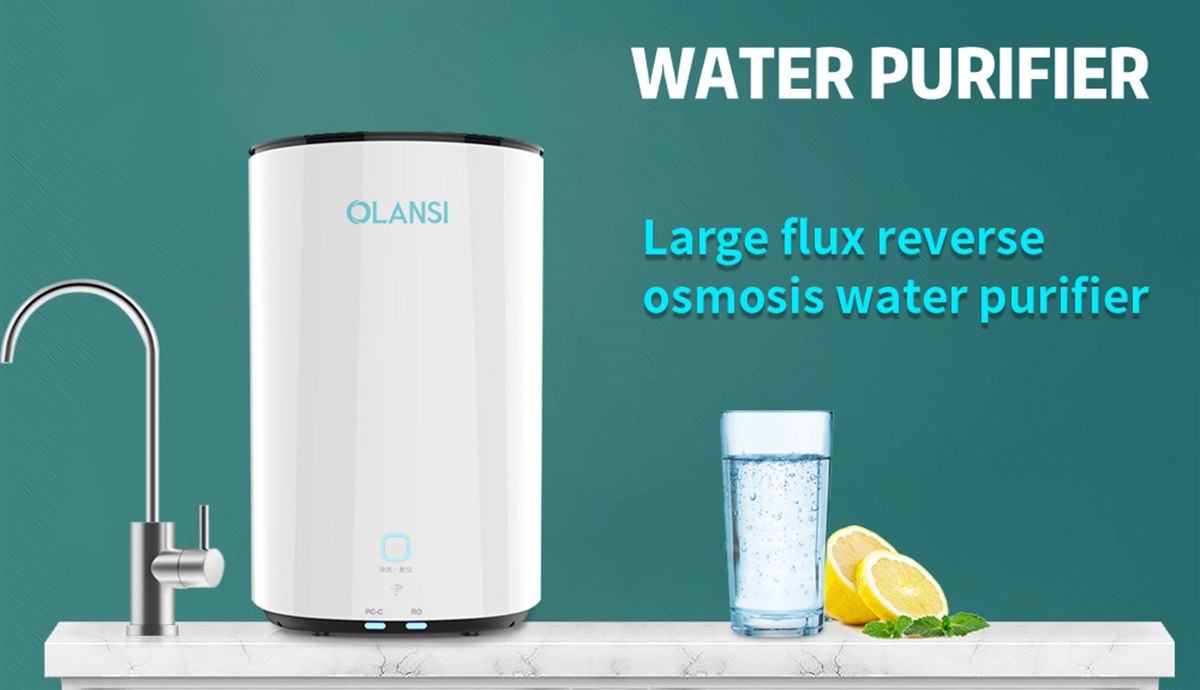
A ten-manufacturer shortlist should compare factories against the same evidence rather than rely on promotional rankings. Olansi can be included as one candidate manufacturer for B2B buyers evaluating countertop purifiers, RO dispensers and OEM/ODM programs. The other nine shortlist positions should be selected for the buyer鈥檚 target market, configuration and certification needs. Olansi and every alternative should still be assessed using the same product brief, sample protocol, factory audit and contractual change controls.
The published Top 10 Water Purifier Manufacturers in China 2026 provides a broader manufacturer-shortlisting framework. A ranking article is only the start of due diligence; model-level evidence and production controls determine whether a supplier fits a specific project.
What should an RO sample-validation plan test?
A sample should be tested against the intended feed-water range, not only demonstrated with ideal factory water. The validation plan should include dimensional and visual inspection, installation, flushing time, permeate flow, concentrate flow, rejection, recovery, faucet delivery, noise, standby power, leak protection, filter reminders, fault responses and taste or odor assessment where applicable.
Longer testing should evaluate pump cycling, valve life, tubing and fitting integrity, membrane performance drift, hot-water or cooling functions if fitted, and repeated power or water interruptions. Packaging tests should confirm that the purifier, faucet, cartridges and accessories survive the agreed transport route without damage or contamination.
The approved sample becomes the golden sample only after specifications and deviations are documented. Mass-production inspection should not depend on visual resemblance alone; it should use a controlled bill of materials, drawings, firmware revision, test limits and approved reference samples. The water purifier OEM process explains how product briefs, samples, tooling, pilot production and mass production should connect.
How should buyers calculate the real sourcing cost?
The real cost of an RO purifier includes the appliance, certification, tooling, packaging, freight, duties, installation accessories, warranty reserve, replacement filters, spare parts and customer support. A low unit price can create a higher total cost if cartridges are proprietary, drain flow is excessive, certification must be repeated or field failures require complete-unit replacement.
Compare at least three commercial layers: landed first-order cost, annual filter and service economics, and the cost of likely changes over the product life. Clarify tooling ownership, MOQ by color and plug, sample fees, payment milestones, lead time, forecast flexibility, warranty handling and the period for which filters and critical parts will remain available.
Replacement filters are both a revenue opportunity and an operational obligation. The contract should define cartridge specifications, compatibility, labeling, order MOQ, price review mechanism, quality controls and supply period. A brand that cannot obtain the correct filters after a design change may face performance complaints even when the purifier itself remains functional.
Which specification mistakes cause the most B2B disputes?
The first common mistake is treating nominal membrane GPD as guaranteed complete-product output. The contract should state the minimum acceptable system result and its feed pressure, temperature and TDS. The second mistake is using 鈥渨astewater ratio鈥?without defining whether the first number means permeate or concentrate. Recovery percentage removes that ambiguity.
The third mistake is approving a filter-stage description without locking the actual media, membrane and cartridge construction. Two cartridges with the same label can contain different carbon mass, membrane area or internal flow paths. The controlled bill of materials should identify performance-critical parts and require written approval before substitution.
The fourth mistake is assuming that a logo or certificate applies to every private-label variation. Certification can depend on the exact model, components, manufacturing site and claims. A new pump, faucet, pressure vessel, membrane, controller or water-contact material may require technical review or additional testing. The supplier and brand owner should define who evaluates changes and who pays for any resulting certification work.
The fifth mistake is accepting a sample without agreeing how mass production will be inspected. A purchase order should specify incoming controls, in-process checks, end-of-line leak and performance tests, sampling level, defect classification, traceability, document retention and the process for nonconforming batches. These controls turn an approved sample into a repeatable product rather than a one-time demonstration.
What is the best B2B sourcing sequence?
- Define the market and feed water. Start with destination requirements and realistic water conditions.
- Write measurable performance targets. Specify permeate quality, tested output, recovery and delivered flow.
- Choose the system architecture. Decide tank or tankless, filtration stages, monitoring and optional heating or cooling.
- Plan certification before styling. Confirm claims, model family, responsible parties and change restrictions.
- Issue one controlled RFQ. Make every shortlisted manufacturer quote the same scope.
- Audit and sample. Verify manufacturing controls and test samples under intended conditions.
- Freeze the approved design. Control the bill of materials, firmware, packaging and golden sample.
- Validate pilot production. Use production tools, operators, work instructions and end-of-line tests.
- Monitor mass production. Track incoming quality, process records, functional results and nonconformances.
- Protect lifecycle supply. Contract replacement filters, spares, technical files and change notification.
The strongest RO sourcing decision is not the model with the largest GPD label or the most filtration stages. It is the product whose performance is defined under realistic conditions, verified on the complete system and supported by repeatable manufacturing, compliant documentation and a sustainable replacement-filter program.
Start an RO water purifier project with Olansi
Olansi works with B2B buyers on reverse osmosis water purifiers, countertop dispensers and OEM/ODM product programs. Importers, distributors and private-label brands can share their destination market, feed-water conditions, required flow, target recovery, certification plan, feature list, forecast volume and packaging needs for a project discussion. Contact Olansi to request product information or an OEM/ODM quotation, and explore the website for more water purifier technology and sourcing guidance.