

Top 10 Sparkling Water Dispenser Manufacturers in China (2027)
The most useful way to compare sparkling water dispenser manufacturers in China is to match each factory’s product architecture, engineering depth, export documentation and after-sales model to a defined B2B project. A company that is strong in manual household soda makers may not be the right source for a 40 L/h under-counter system, while a commercial refrigeration specialist may not offer the cost structure or styling flexibility required by a retail appliance brand.
This 2027 shortlist presents ten China-based manufacturer candidates with publicly visible sparkling-water products or manufacturing capabilities. It is not a claim that one company is universally better than another. Buyers should verify every factory, certificate, model and production claim before contracting. The list is designed for importers, distributors, private-label brands, hospitality suppliers, office-water operators and project buyers that need a practical starting point.
Top 10 sparkling water dispenser manufacturers in China for 2027
- Olansi Healthcare – Guangzhou, Guangdong
- 4 Degree / Foshan Mia Electrical Appliance Manufacturing – Foshan, Guangdong
- Koldaro – Foshan, Guangdong
- JNOD – Foshan, Guangdong
- Ningbo Qiangxin Intelligent Technology – Ningbo, Zhejiang
- Ningbo Kangtan Intelligent Technology – Ningbo, Zhejiang
- Zhejiang Lonsid Health Drinking Water Equipment – Zhejiang
- Suzhou Puretal Electric – Suzhou, Jiangsu
- Bestware Hardware Production – Jiangmen, Guangdong
- Electrotemp Technologies China – Ningbo, Zhejiang
The sequence is editorial rather than a performance ranking. Public information changes, and a corporate website cannot replace model-level testing or a factory audit. The right shortlist becomes clear only after the buyer defines water modes, continuous output, installation format, destination-country requirements, OEM scope and expected annual volume.
How were the manufacturers selected?
A company was considered when public information showed a China manufacturing location and a sparkling-water appliance, dispenser, carbonator or closely related production program. Preference was given to companies that publish product specifications, factory information, OEM or ODM services, quality controls, manuals or model evidence. Marketplace listings were used only to discover possible suppliers and were not treated as proof of manufacturing capability.
Five types of evidence matter more than a promotional ranking: a traceable legal manufacturer, a product that matches the requested format, test capability for pressure and refrigeration performance, destination-market documentation, and a workable supply plan for filters, CO2 interfaces and spare parts. A buyer should ask each candidate to substantiate these points with current documents tied to the quoted model.
| Manufacturer candidate | Publicly visible focus | Potential buyer fit | Key point to verify |
|---|---|---|---|
| Olansi | Purification, countertop dispensers and OEM/ODM appliances | Brands combining filtration and sparkling-water functions | Exact platform, target-market tests and customization scope |
| 4 Degree / Foshan Mia | Countertop soda makers, dispensers, bottles and CO2-related systems | Retail appliance brands and design-led ODM programs | Platform capacity, tooling ownership and gas-cylinder logistics |
| Koldaro | Countertop, under-counter and point-of-use sparkling dispensers | Office, hospitality and water-service channels | Continuous output and certifications for the selected configuration |
| JNOD | Countertop and under-counter chilled sparkling appliances | Importers seeking filtration and appliance customization | Production scope, refrigeration endurance and service parts |
| Ningbo Qiangxin | Residential and commercial sparkling-water dispensers | Home, office and Horeca product programs | Model-specific listings behind public certification claims |
| Ningbo Kangtan | Manual and household soda makers | Retail, promotional and portable carbonation programs | Bottle life, burst testing and CO2 interface specification |
| Lonsid | POU hot, cold, ambient and sparkling dispensers | Established water-dispenser distribution channels | Current model availability and OEM program boundaries |
| Puretal | Water purification, dispensers and soda-water appliances | Buyers needing a broader water-appliance portfolio | Which sparkling models are made in-house and their test evidence |
| Bestware | Commercial taps and 3-in-1 or 4-in-1 sparkling systems | Hospitality, offices and high-output under-counter projects | Complete system responsibility and local installation requirements |
| Electrotemp China | Water coolers, POU dispensers and sparkling-water models | Volume water-cooler programs and floor-standing formats | Current OEM contact, model ownership and factory audit evidence |
1. Olansi Healthcare
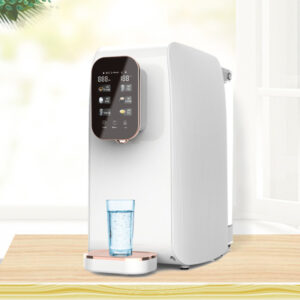
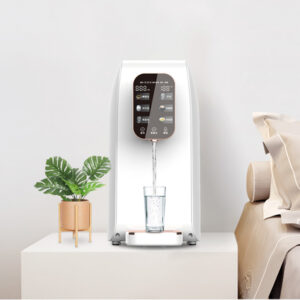
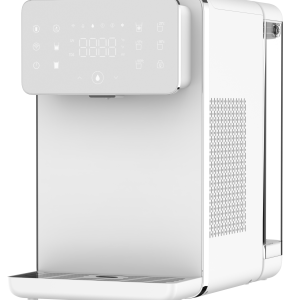
Olansi is a Guangzhou-based water and air treatment appliance manufacturer with product experience in water purifiers, countertop dispensers and related OEM/ODM programs. For a sparkling-water project, Olansi is most relevant when the product brief combines treatment functions with a consumer or light-commercial appliance, rather than treating carbonation as an isolated accessory.
A B2B buyer can evaluate Olansi for housing customization, filtration configuration, user-interface requirements, packaging and private-label development. The qualification process should still be model specific: confirm the carbonator and cooling architecture, wetted materials, usable output at peak demand, noise, electrical configuration, required certification and filter replacement plan. Olansi should be compared against the same acceptance sheet as every other candidate.
2. 4 Degree / Foshan Mia Electrical Appliance Manufacturing
4 Degree presents a combined design and manufacturing structure in Foshan. Its public website states that Foshan Mia builds countertop water dispensers, soda makers and bottles in an in-house facility, while the related commercial entity handles contracting and export documentation. The published range spans manual carbonation products, electronically controlled machines and a dispensing platform.
This candidate may suit a brand that values industrial design, bottle development and private-label adaptation around an existing platform. Its public OEM information discusses color, finish, logo, packaging, housing and tooling. Buyers should define who owns new molds, whether bottle and CO2 connections are proprietary, which components are locked, and what pressure and life tests are performed on every production batch.
3. Koldaro
Koldaro publicly markets countertop, under-counter, tank and point-of-use sparkling-water formats from Foshan. That breadth may be useful to distributors serving office, hospitality or food-service channels, because the sourcing discussion can begin with installation and output rather than with one consumer soda-maker format.
The critical comparison is not the number of listed models but verified performance under a common test. Ask for chilled and sparkling continuous output, recovery time after peak draw, carbonation level, ambient-temperature test conditions, refrigerant, ventilation clearances and expected compressor duty cycle. Any certificate should identify the precise model and production site in the quotation.
4. JNOD
JNOD is located in Shunde, Foshan and publishes countertop and under-counter sparkling-water products for distributors, appliance brands and OEM/ODM customers. Its public materials emphasize chilled-water appliances, filtration integration and private-label cooperation. That positioning may fit importers that want a compact appliance rather than a stand-alone manual carbonator.
JNOD should be evaluated on its engineering ownership and production boundaries. Buyers can request internal waterway diagrams, refrigeration component specifications, carbonator material, pressure control logic, leak protection and sanitation instructions. Sample testing should include the first glass after idle time, repeated peak draws and operation near the maximum rated room temperature.

5. Ningbo Qiangxin Intelligent Technology
Ningbo Qiangxin describes itself as a specialist developer and manufacturer of residential, office and Horeca sparkling-water dispensers. Its public history links the current appliance operation to earlier mold and injection-molding activity, which may be relevant to buyers seeking custom housings and integrated product development.
The company website also presents international certification claims. Buyers should request official database links or complete reports for the exact model rather than relying on logos. A useful audit would check molding control, carbonator production or sourcing, leak and pressure tests, refrigeration testing, electrical safety records, serial traceability and complaint-correction records.
6. Ningbo Kangtan Intelligent Technology
Ningbo Kangtan focuses more clearly on household and portable soda makers than on large chilled POU systems. Its public factory information describes pressure, bottle and leakage testing, along with food-contact reports and patent activity. This specialization can make it a candidate for retail brands that need a manual carbonation appliance, reusable bottle and compact gift-box product.
The evaluation should concentrate on the pressure system. Confirm the compatible CO2 cylinder standard, pressure-relief method, bottle material and allowable service life, batch burst-test procedure, carbonation repeatability and misuse testing. A supplier that is suitable for a manual soda maker should not automatically be assumed suitable for a refrigerated commercial dispenser; those are different product and compliance programs.
7. Zhejiang Lonsid Health Drinking Water Equipment
Lonsid has a long-established public profile in water dispensers and purification equipment. Recent corporate material shows a countertop or under-sink product that supplies multiple water modes including sparkling water, while older product information also describes POU hot, cold, ambient and sparkling configurations.
This background may appeal to a distributor already buying conventional water coolers and seeking to add sparkling functionality. The buyer should confirm that the referenced sparkling model is currently offered, identify the manufacturing entity on the contract, and review current technical files. Product longevity also depends on whether the supplier will maintain compatible filters, controllers, faucets and carbonation parts throughout the agreed sales period.
8. Suzhou Puretal Electric
Puretal presents itself as a Suzhou manufacturer of water purifiers, dispensers, soda-water filters and machines. Its broad portfolio may fit buyers that want sparkling water as one category within a larger private-label water-treatment range, because sourcing, packaging and replacement-filter programs can potentially be coordinated across related products.
Broad capability must be separated from model ownership. Ask which sparkling appliances are designed and assembled at the stated facility, which modules are outsourced, and what test stations are installed for pressure, cooling and water quality. Public statements about patents, exports or certifications should be supported by model-level documentation during qualification.
9. Bestware Hardware Production
Bestware in Jiangmen publicly shows commercial 3-in-1 and 4-in-1 systems combining chilled, sparkling, ambient and, in some configurations, hot water. Product manuals and catalog information indicate under-counter equipment paired with stainless-steel dispensing towers. This architecture targets offices, hospitality venues and premium shared spaces rather than the portable soda-maker market.
A commercial buyer should clarify whether Bestware supplies the complete filtration, chilling, carbonation and faucet package or only selected modules. Installation details matter: inlet pressure, drainage, ventilation, CO2 cylinder placement, sanitization access, electrical load and local service procedures can determine project success. Continuous liters per hour should be verified at the specified inlet-water and room temperatures.
10. Electrotemp Technologies China
Electrotemp Technologies China appears in public supplier material with a wide water-cooler range and several sparkling-water dispenser configurations, including floor-standing compressor-cooled appliances. This makes the company a potential candidate for buyers whose channel already handles conventional coolers and wants a familiar cabinet format with carbonation added.
Because much of the visible information appears in trade directories, direct verification is especially important. Buyers should obtain the current corporate website or official sales contact, business license, factory address, model drawings, certification files and production evidence. Confirm whether the factory owns the quoted design, whether it controls the sparkling-water module, and whether the same configuration has a documented export history.
What do the leading search results cover, and what do they miss?
The five most useful non-shopping results reviewed for this article were the existing Olansi B2B sourcing guide and official pages from 4 Degree, Koldaro, Puretal and Ningbo Qiangxin. Collectively, these pages explain available formats, OEM positioning, factory claims and common product capabilities. They help a buyer discover suppliers, but they do not create a normalized comparison.
The common gap is evidence structure. Supplier pages naturally describe their own strengths, while many list articles mix household soda makers, commercial dispensers, water coolers and beverage systems as if they were interchangeable. Public pages rarely normalize output at the same ambient and inlet-water temperature, identify which certificates apply to which models, quantify spare-parts support, or explain how engineering changes are controlled after approval.
This article adds a buyer-fit framework, product-architecture distinctions, regional context and a model-level verification checklist. For a detailed explanation of carbonation technology, formats, CO2 planning, sample tests and general sourcing, use the separate Sparkling Water Dispensers B2B Sourcing Guide. Keeping the two angles separate avoids repeating a general technology guide inside a manufacturer shortlist.
Which Chinese manufacturing cluster fits each project?
Guangdong is a strong sourcing region for complete drinking-water appliances, injection-molded housings, refrigeration components, stainless-steel faucets and export packaging. Foshan and Guangzhou are especially relevant to countertop purifiers and OEM/ODM appliances, while Jiangmen has deep stainless-steel and commercial faucet capability. A Guangdong shortlist can therefore be effective for integrated under-counter and design-led dispenser projects.
Ningbo and the wider Zhejiang manufacturing base are strong in small appliances, water coolers, plastics, molds and household carbonation products. This cluster is attractive for portable soda makers, floor-standing cooler formats and programs that require developed molding and appliance supply chains. Suzhou and Jiangsu add water-treatment, electronics and appliance manufacturing options for buyers combining purification with dispensing.
Location alone does not prove quality, but it affects supplier ecosystems, tooling access, component lead times and audit travel. Buyers can reduce qualification cost by grouping factory visits geographically after the technical shortlist has been narrowed.
How should buyers match product architecture to a manufacturer?
| Product architecture | Best-fit channel | Core supplier capability | Main qualification risk |
|---|---|---|---|
| Manual household soda maker | Retail, e-commerce and promotions | Pressure mechanism, bottle production and molding | Bottle life, cylinder compatibility and misuse safety |
| Countertop chilled dispenser | Homes, small offices and appliance retail | Compact refrigeration, controls and waterway integration | Low output in warm conditions and excessive noise |
| Freestanding POU dispenser | Office-water and institutional distribution | Cooler cabinets, filtration, service access and volume assembly | Field service burden and proprietary consumables |
| Under-counter commercial system | Hospitality, offices and premium kitchens | High-output chilling, carbonator, tower and installation engineering | Incorrect sizing, ventilation and sanitation planning |
| Integrated hot/cold/ambient/sparkling system | Premium commercial and residential projects | Thermal management, electronics and multiple safety functions | System complexity and service-parts availability |
A buyer should select the architecture before selecting the factory. Asking ten unrelated suppliers for a generic “sparkling water dispenser” quote will produce prices for different products and create a false comparison. A controlled RFQ should state the installation, duty cycle, water modes, output, cooling conditions, carbonation target, filtration, CO2 connection, electrical supply, certification market and OEM scope.
How can a buyer verify that a supplier is a real manufacturer?
Start by matching the company name on the business license, quotation, bank account, test reports and export documents. If different entities handle design, production and export, map the relationship in the supply agreement. A legitimate multi-entity structure can work, but responsibility for quality, warranty and intellectual property must be unambiguous.
During a factory audit, follow one current model from incoming components to finished-goods records. Verify incoming inspection of carbonators, regulators, valves, compressors, pumps, filters and food-contact parts. Observe tube insertion, seal assembly, torque control, refrigerant handling, electrical tests, leak tests, pressure tests, cooling tests, sanitation and final inspection. Ask how test results are linked to a serial number or production batch.
Engineering evidence separates a product owner from a catalogue reseller. Request controlled drawings, a bill of materials, risk analysis, firmware revision records, reliability plans, tooling records and corrective-action examples. A factory does not need to make every component, but it should understand critical specifications and control approved suppliers.
Which technical data should every quotation contain?
- Installation format, dimensions, net weight, required clearances and rated duty
- Available water modes and dispensing temperature range for each mode
- Chilled and sparkling output in liters per hour at stated test conditions
- Carbonation target, adjustment range, regulator setting and pressure-relief design
- CO2 cylinder interface, acceptable cylinder sizes and destination-market logistics
- Carbonator, tank, tube, fitting and faucet materials in contact with water
- Filtration stages, cartridge codes, tested capacity and replacement cost
- Electrical rating, refrigerant, compressor, peak power, standby use and noise
- Leak protection, fault response, hot-water safety and sanitation procedure
- Applicable test reports, certificate holder, model number and manufacturing site
- MOQ, sample lead time, production lead time, warranty and spare-parts commitment
- OEM options, tooling ownership, approved BOM and change-notification process
Every performance number needs conditions. A claim of 30 L/h is incomplete without inlet-water temperature, room temperature, outlet-temperature limit and test duration. Carbonation should be evaluated by a defined method, not by a photograph of bubbles. A certificate logo is incomplete without a listing, report or declaration that identifies the quoted product.
What should buyers test before approving mass production?
The first sample round should confirm installation, user experience and basic function. The engineering round should measure temperature, output, carbonation consistency, recovery after repeated draws, noise, power use, pressure stability and leak response. Tests should include intended worst-case room and inlet-water conditions because refrigeration performance often falls as ambient temperature rises.
Reliability testing should cover compressors, pumps, valves, buttons, touch controls, seals, bottles where applicable, and repeated carbonation cycles. Water-contact materials, taste and odor, sanitation access and microbial-control features should be evaluated against the intended market and use. Packaging tests must represent the actual freight route and accessory layout.
The approved golden sample should be supported by controlled drawings, firmware, packaging files and a signed bill of materials. Pilot production then tests whether ordinary operators, tools and inspection stations can reproduce the result. The broader water purifier OEM process explains how a product brief should progress through samples, tooling, pilot production and mass production.
How should OEM scope and margin be compared?
Private labeling an existing platform usually requires less investment and reaches the market faster. Color, logo, packaging, manual and filter configuration may be changed without redesigning the core machine. A deeper ODM program can create differentiation through housing, faucet, interface or water-path changes, but it adds tooling, validation, certification and inventory risk.
Unit price is only one part of distributor margin. Buyers should model landed equipment cost, CO2 solution, filter revenue, replacement-filter freight, warranty reserve, installation accessories, local service time and expected product life. A slightly higher-cost dispenser may create a better operating margin if its consumables are available, service access is simple and field failure is lower.
Contract terms should protect the commercial model. Define territory, branding, tooling ownership, background intellectual property, exclusivity conditions, forecast commitments, warranty credit, spare-parts pricing and the minimum support period. Require written approval before any change to pressure components, compressor, controller, water-contact materials or certified parts.
What red flags should disqualify a supplier?
A supplier should be reconsidered when its company identity changes between documents, it cannot identify the factory that makes the quoted model, or it refuses a live production audit. Other red flags include certificates that show a different model, unexplained component substitutions, performance data without test conditions, and a quotation that omits the CO2 interface or installation requirements.
A very low quote can indicate a different duty rating, smaller cooling system, non-equivalent materials or an incomplete package. Compare the exact bill of materials and acceptance tests before negotiating price. Also investigate how the supplier handled past quality problems; a documented corrective action is more informative than a claim of zero defects.
How should a final shortlist be built?
- Freeze the product brief. Define the channel, installation, water modes, peak demand, target markets and annual volume.
- Choose the supplier archetype. Decide whether the project needs a soda-maker specialist, a purification-appliance OEM, a water-cooler factory or a commercial system integrator.
- Issue one evidence-based RFQ. Require every supplier to answer the same specification and document questions.
- Score evidence separately from claims. Give more weight to model-specific reports, measured samples and audit records than to website statements.
- Test two or three finalists. Use identical water, gas, ambient conditions and draw cycles.
- Audit before tooling or deposit. Confirm the legal entity, actual production scope and quality controls.
- Approve a pilot lot. Verify that mass-production processes reproduce the engineering sample.
- Contract lifecycle support. Lock change notification, filters, critical spares, warranty handling and document maintenance.
The best sparkling water dispenser manufacturer is the one that can repeatedly produce the buyer’s approved specification, not the company with the longest product list. A transparent scoring sheet makes the decision defensible and prevents marketing claims from replacing engineering evidence.
Discuss a sparkling water dispenser project with Olansi
Olansi supports B2B buyers evaluating water purification appliances, countertop dispensers and OEM/ODM sparkling-water programs. Importers, distributors and private-label brands can share their target market, preferred format, water modes, output requirement, filtration plan, CO2 connection, certification needs, forecast volume and customization scope for an initial project review.
Explore the sparkling water dispenser range, review the OEM/ODM manufacturing guide, or contact Olansi to request product information and a B2B quotation. More water-treatment and sourcing resources are available throughout the Olansi website.