
Instant Heating vs Tank Heating in Water Dispensers: Energy, Safety and Temperature Accuracy
Quick answer: Instant heating and tank heating are the two ways a water dispenser makes hot water:
- Instant heating: A high-power flow-through heater, typically about 2,000-2,200 W on 220-240 V supplies, heats water only while it is being dispensed. It reaches drinking temperature in a few seconds.
- Tank heating: A lower-power element, typically about 400-700 W, keeps a small reservoir of water hot at all times.
Instant heating usually uses less energy, because it has no standby heat loss. It offers precise, selectable temperatures and avoids storing warm water. Tank heating delivers a fast, high flow of hot water from a lower electrical load, but it loses heat continuously and gives less precise temperature control. The right choice depends on usage pattern, power supply, water quality and the market the dispenser is sold in.
What this guide adds: an engineering comparison with worked energy figures, temperature control and safety details, the effect of 110-120 V supplies, scale and water quality, a specification checklist for brands, and ten leading manufacturers. For a general overview of instant hot dispensers, see the instant hot and cold water dispenser technical guide.
How does tank heating work in a water dispenser?
A tank-heated water dispenser keeps a small stainless steel reservoir, commonly about 0.5-1.5 litres, filled with water and heated by an immersed or band heater. A thermostat or temperature sensor switches the heater on when the water cools below a set point and off when it reaches the upper limit, often around 85-95 °C. When the user dispenses hot water, fresh water flows into the tank and is heated back up.
The main advantage of tank heating is that a full tank of hot water is ready at any time and can be dispensed at a high flow rate, which suits filling teapots or several cups in a row. The heater power is moderate, so the dispenser works comfortably on standard household circuits. The main disadvantage is that the tank loses heat to its surroundings all day and night. The heater must replace that heat even when nobody uses the dispenser.
How does instant heating work in a water dispenser?
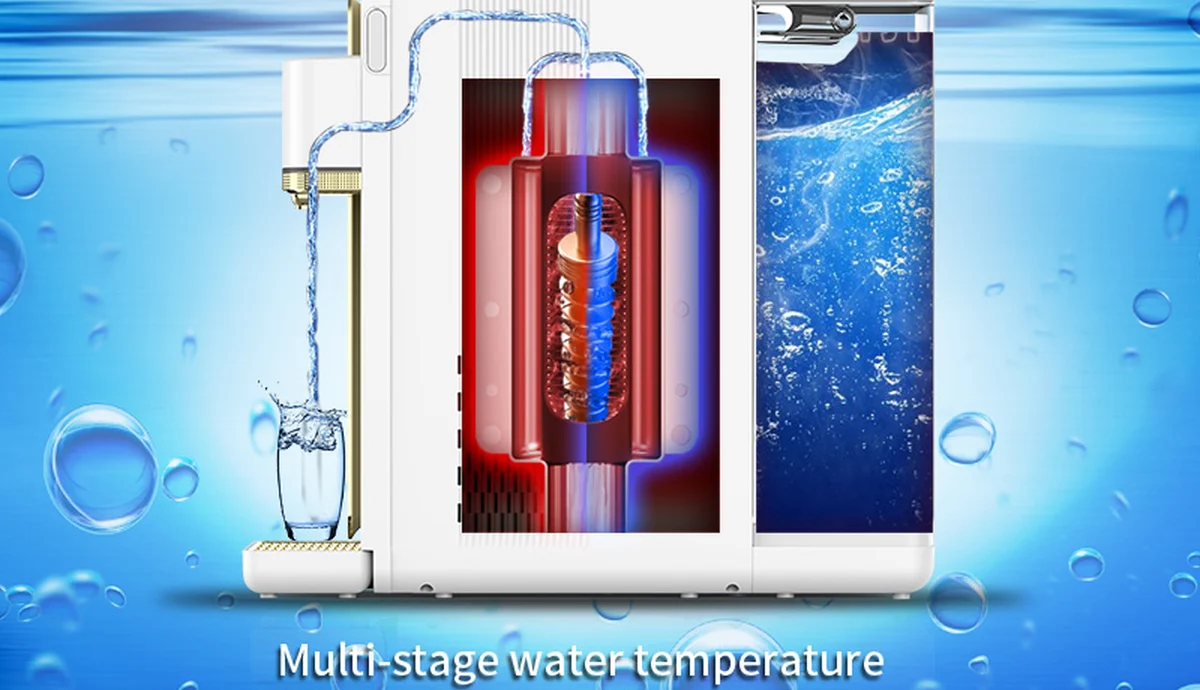
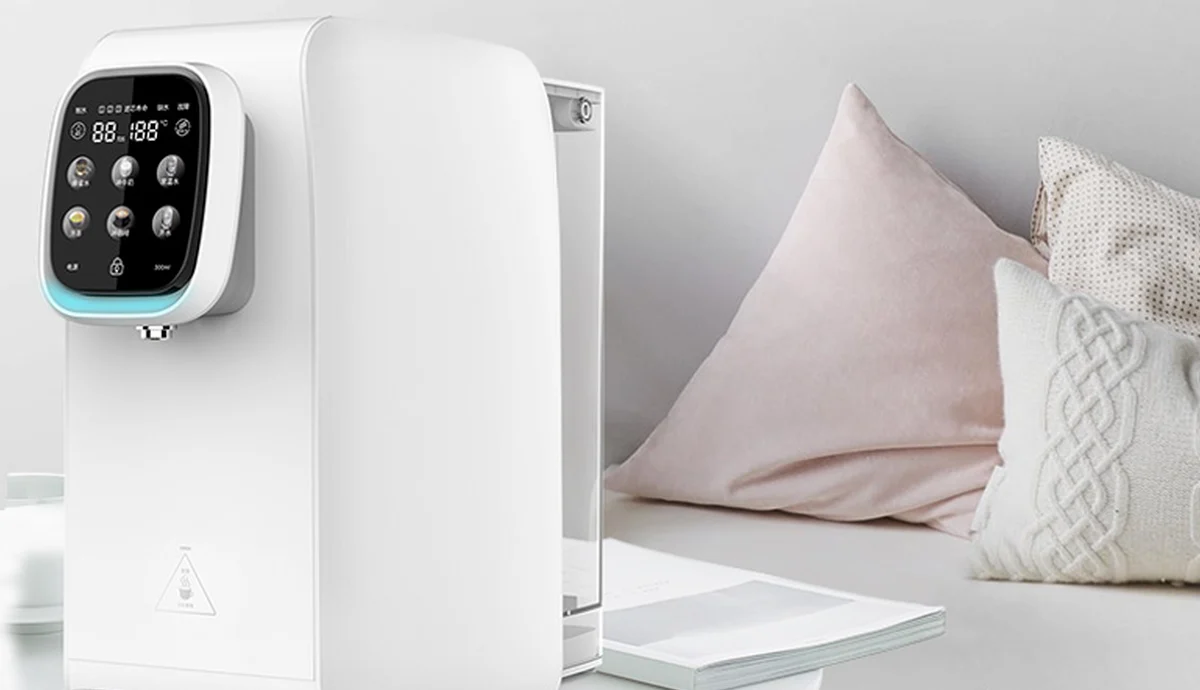
An instant heating dispenser has no hot water tank. When the user selects hot water, a pump draws water from the cold or ambient tank through a compact flow-through heater. This is usually a thick-film heater printed on a stainless steel or ceramic substrate, or a tubular heater around a small flow channel. The heater delivers high power for a few seconds, and an electronic controller adjusts power and flow to reach the selected temperature at the outlet.
Because water is heated only when needed, an instant dispenser has almost no standby heat loss and no stored warm water. It can also offer several temperature presets, such as 45 °C for baby formula, 70-85 °C for green tea and coffee, and 90-95 °C for black tea and instant food, from the same heater. The trade-off is limited flow at high temperature, since the flow rate is set by the heater power. Different instant designs are described in types of instant hot water dispensers.
How do instant and tank heating compare on energy use?
Energy use has two parts: the energy needed to heat the water that is actually used, and the energy lost while waiting. Heating 1 litre of water from 25 °C to 95 °C takes about 0.08 kWh, whichever technology is used. Instant heaters convert electricity to heat in the water with high efficiency, because almost all the heat goes directly into the flowing water. Tank heaters also heat efficiently, but they add standby losses from the hot tank. Depending on tank size, insulation, setpoint and room temperature, these losses commonly amount to a few hundred watt-hours per day.
Worked example: Consider an office dispenser that supplies 3 litres of hot water per day.
- Heating the water itself needs about 3 x 0.08 = 0.24 kWh.
- An instant heater uses roughly that amount, about 0.25 kWh per day.
- A tank model with 0.4 kWh of daily standby loss uses about 0.64 kWh per day, roughly 2.5 times as much.
Over a year, the difference is about 140 kWh per dispenser. When use is very high and the tank is constantly being refilled, standby loss becomes a smaller share of the total and the gap narrows. When use is low, as in many homes, standby loss dominates and instant heating saves more.
| Factor | Instant heating | Tank heating |
|---|---|---|
| Heater power | High, typically 2,000-2,200 W at 220-240 V | Moderate, typically 400-700 W |
| Standby heat loss | Almost none | Continuous, depends on insulation and setpoint |
| Energy use at low daily volume | Low | Dominated by standby loss |
| Energy use at high daily volume | Low | Closer to instant, as standby share falls |
| Peak electrical demand | High for short periods | Low and steady |
Energy rules increasingly favour low standby consumption, as discussed in selling water dispensers in the EU.
How fast and how much hot water can each technology deliver?
Instant heaters deliver hot water within a few seconds, but their flow rate at high temperature is limited by heater power. Heating water by 70 °C at 0.5 litres per minute needs about 2,440 W. A 2,100 W heater therefore delivers roughly 0.43 litres per minute at that temperature rise, and faster at lower temperatures. That is enough for cups and mugs, but filling a large flask takes longer than with a tank.
Tank dispensers can deliver their stored hot water at a high flow rate, often limited only by the valve and outlet. Once the tank is emptied, however, the user must wait for the moderate-power heater to reheat the new water, which can take several minutes. Instant heating suits frequent small servings with selectable temperatures. Tank heating suits occasional large volumes at one fixed temperature.
Which technology gives better temperature accuracy?
Instant heating generally gives better temperature accuracy and more temperature choices. An instant heater uses a temperature sensor at the heater outlet and adjusts power, and often pump speed, in real time. Well-designed units hold the dispensed temperature within a few degrees of the selected preset across the serving. Users can choose several presets for tea, coffee, formula and cooking, because the controller sets the temperature for each serving.
Tank heating keeps water within a temperature band rather than at one exact value. The thermostat switches on and off with a hysteresis of several degrees, and the first cup after a long pause may be at the upper end of the band while later cups cool toward the lower end. Most tank dispensers offer one hot temperature only. Users who want precise temperatures for green tea or baby formula therefore get more consistent results from instant heating.
| Use | Typical temperature | Instant heating | Tank heating |
|---|---|---|---|
| Baby formula | About 45 °C | Dedicated preset | Requires mixing with cold water |
| Green and white tea | About 70-85 °C | Dedicated preset | Usually too hot |
| Coffee | About 85-90 °C | Dedicated preset | Close to tank setpoint |
| Black tea and instant food | About 90-95 °C | Dedicated preset | Typical tank setpoint |
How do instant and tank heating compare on safety?
Both technologies can be made safe, but they manage different risks:
- Instant heaters: Use high power, so they need reliable dry-run protection, overheating protection with a thermal fuse or cut-out, flow detection and leak protection. Since hot water is produced only on demand, there is no reservoir of near-boiling water that could escape if the dispenser is knocked over.
- Tank heaters: Hold near-boiling water continuously, so the tank, valves and outlet must prevent unintended release, and the heater must be protected against running dry.
Scald protection is essential for both, especially in homes with children. Common features are a child lock on the hot water outlet, a two-step dispense action, an indicator light, and outlets positioned to keep hands away from the hot stream. Electrical safety for both designs is covered by household appliance safety standards for appliances that heat liquids. Brands should make sure certification testing includes the specific heater and control combination in the final product. Market approvals are summarised in water purifier and air purifier certifications by market.
Which technology is more hygienic?
Instant heating has a hygiene advantage because it does not store warm water. Any tank that holds water at lukewarm temperatures for long periods can encourage microbial growth. A properly operating hot tank is usually kept hot enough to limit growth, but problems can occur if the heater is switched off, set too low or left unused, or if the tank is not cleaned. Instant heaters heat fresh water from the filtered supply for each serving and leave little water in the heating path between uses.
Hygiene also depends on the rest of the dispenser. Both designs benefit from UV sterilisation of the cold or ambient tank, periodic hot water flushing, food-grade materials, and easy cleaning of drip trays and outlets. Filtration and RO before the heater improve both taste and hygiene. Maintenance practices are explained in maintenance tips for bottleless water dispensers.
How do supply voltage and power limits affect the choice?
Supply voltage strongly affects instant heating performance. On 220-240 V supplies, a 2,000-2,200 W instant heater fits comfortably on a normal domestic circuit. On 110-120 V supplies, as in North America and parts of Asia and Latin America, a standard 15 A outlet limits continuous load to roughly 1,440-1,800 W. A lower-power instant heater delivers less flow at high temperature, roughly 0.3 litres per minute or less at a 70 °C rise.
For 110-120 V markets, manufacturers can use lower-power instant heaters with a slower flow, hybrid designs with a small pre-heating volume, or tank heating, depending on customer expectations. Brands selling in both voltage regions often offer instant heating in 220-240 V markets and adjust the design or set user expectations for 110-120 V versions. Checking the target voltage and plug type at the specification stage avoids disappointed users and returns.
How do scale and water quality affect each heating method?
Scale forms when hard water is heated and calcium carbonate deposits on hot surfaces. Instant heaters are more sensitive to scale, because their compact, high-power heating surfaces run hot and have small flow channels. Scale reduces heat transfer and can cause overheating cut-outs. Tank heaters also scale, but their larger elements and reservoirs tolerate it for longer before performance drops.
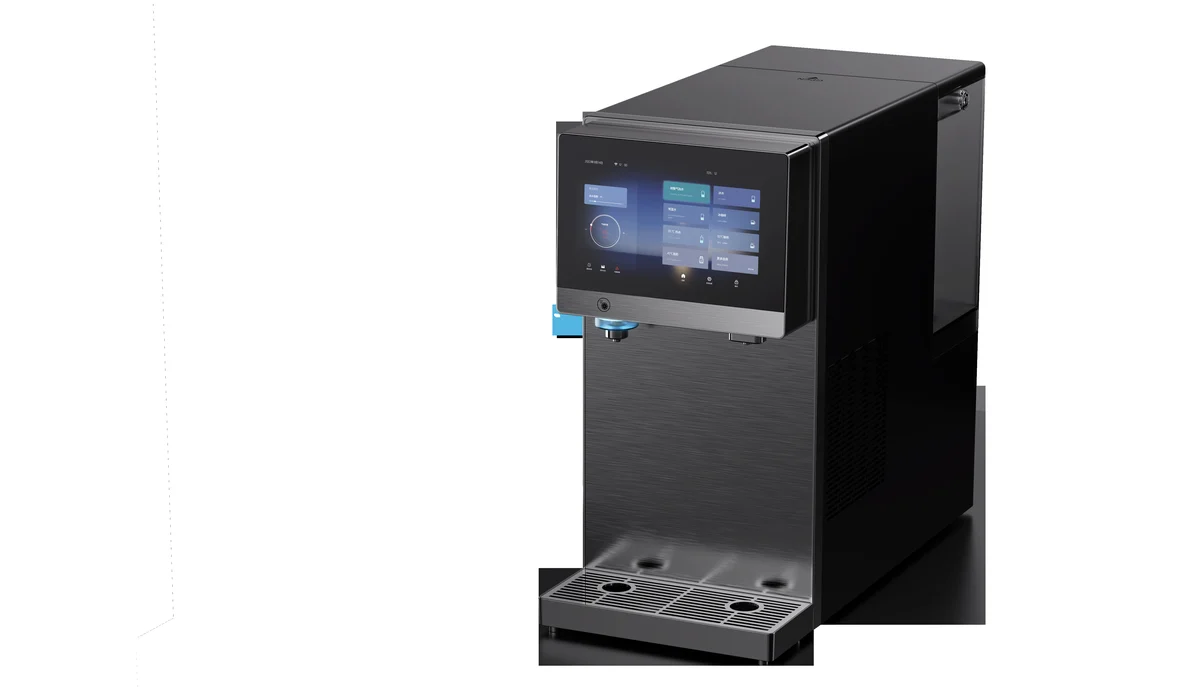
The best protection for both technologies is to treat the water before it is heated. Dispensers that combine reverse osmosis or softening filtration with instant heating avoid most scaling, which is one reason instant heating is commonly paired with RO countertop dispensers. Where RO is not used, descaling instructions and scale-resistant heater designs extend service life. The RO process is explained in the reverse osmosis water purifiers B2B guide.
Which applications suit instant heating and which suit tank heating?
Each technology fits different usage patterns:
- Instant heating: Suits homes, small offices, bedrooms and hotel rooms, where hot water is used in small, frequent servings, where precise temperatures matter, and where energy saving and hygiene are selling points. It is especially popular in countertop RO dispensers sold online.
- Tank heating: Suits busy offices, meeting rooms, canteens and waiting areas, where many cups are filled in a short time at one temperature. It also suits 110-120 V markets where high-power instant heating is limited.
Some products combine both approaches. They use instant heating for precise temperatures and a small insulated buffer for higher flow, or allow the hot function to be switched off when not needed. Choosing the technology by application, rather than by trend, gives the best user experience.
What should brands specify when sourcing dispensers by heating type?
Brands and distributors sourcing dispensers should specify the heating method together with:
- heater power and supply voltage
- hot water flow rate at each temperature preset
- temperature presets and accuracy
- standby power with the hot function on and off
- safety features: dry-run protection, thermal cut-out, child lock, leak detection
- heater material and scale resistance
- compatibility with the filtration system
- the certification needed for each market
Samples should be tested for time to first hot water, temperature accuracy across a full serving, energy use over a 24-hour period with typical usage, and behaviour with local water.
The heating method also affects the bill of materials, packaging weight and service parts. Instant heaters, pumps and control boards should be included in the spare parts plan, and replacement procedures should be documented for service teams. The wider sourcing process is described in the countertop and bottleless water dispenser sourcing guide.
How do instant and tank heating compare on total cost of ownership?
Total cost of ownership combines purchase price, electricity, filters, maintenance and service life:
- Purchase price: Instant heating dispensers usually cost more to buy, because the flow-through heater, pump, temperature sensors and electronic controller cost more than a simple tank and thermostat.
- Electricity: Instant models usually cost less to run, because they avoid standby losses. At an electricity price of 0.25 per kWh in local currency, saving about 140 kWh per year saves about 35 per dispenser per year. Across a fleet of office or hotel units, the saving becomes significant.
- Maintenance: Tank dispensers need periodic tank cleaning and descaling. Instant dispensers need clean, filtered water to protect the heater, so filter replacement on schedule is part of their running cost.
For brands, a clear running cost comparison is a strong sales argument, especially in markets with high electricity prices.
Instant or tank heating: which should you choose?
The table below summarises the comparison by decision factor, so buyers can match the heating method to their market and application.
| Decision factor | Better choice | Reason |
|---|---|---|
| Lowest energy use at low or moderate demand | Instant heating | No standby heat loss |
| Precise and multiple temperatures | Instant heating | Sensor and power control per serving |
| No stored warm water | Instant heating | Water heated only on demand |
| High flow of hot water for large containers | Tank heating | Stored hot water dispenses quickly |
| Low electrical load or 110-120 V supply | Tank heating | Moderate heater power |
| Lowest purchase price | Tank heating | Simpler components |
| Hard water without pre-treatment | Tank heating | Larger heating surfaces tolerate scale longer |
Which manufacturers lead in instant and tank heating water dispensers?
Brands and distributors comparing instant and tank heating dispensers usually consider both large appliance groups and specialist OEM/ODM manufacturers. The ten companies below are widely known for producing water dispensers or purifier dispensers with heating functions. They are listed in no particular order.
- OLANSI Healthcare (Guangzhou, China): A manufacturer of instant hot and cold water dispensers, countertop RO dispensers, sparkling water dispensers and water purifiers since 2009, with a 60,000 m² factory, in-house moulding and a water laboratory. It focuses on OEM/ODM supply for brands and distributors.
- Midea Group (Guangdong, China): A large home appliance group producing water dispensers with both tank and instant heating.
- Haier (Qingdao, China): A global appliance group with water dispensers and purifier dispensers sold under several brands.
- Angel Drinking Water (Shenzhen, China): A Chinese specialist in water purifiers and drinking water dispensers.
- Qinyuan (Zhejiang, China): A Chinese water treatment company producing purifiers and drinking water equipment.
- A. O. Smith (United States): A water heating and water treatment company with purifier and dispenser products in several markets.
- Coway (South Korea): A maker of water purifiers, including countertop hot and cold purifier dispensers.
- LG Electronics (South Korea): An appliance company offering countertop water purifier dispensers with hot water functions.
- Xiaomi (Beijing, China): A consumer electronics company whose ecosystem includes instant hot water dispensers and water purifiers.
- Electrolux (Sweden): A home appliance company that offers water dispensers in a number of markets.
For private-label buyers, the main difference is flexibility. Large brands mainly sell their own products, while specialist OEM/ODM manufacturers such as OLANSI customise heating method, temperature presets, voltage versions and branding for each market.
Frequently asked questions
Does an instant hot water dispenser use more electricity than a tank dispenser?
An instant heater draws more power while it is heating, but only for a few seconds per serving, and it has almost no standby loss. In most homes and small offices, its total daily energy use is lower than that of a tank dispenser that keeps water hot all day.
Why is the flow slower from an instant hot dispenser?
The flow rate of an instant heater is limited by its power. A 2,100 W heater can raise water by about 70 °C at roughly 0.4-0.5 litres per minute, so high-temperature water flows more slowly than from a tank of pre-heated water.
Is instant heating suitable for 110 V markets?
Instant heating works on 110-120 V supplies, but heater power is limited by circuit ratings, so hot water flow is lower. Manufacturers adapt designs for these markets with lower-power heaters, small buffer volumes or tank heating.
Which heating method is better for baby formula?
Instant heating is usually better for formula, because it can deliver water at a precise lower temperature, such as about 45 °C, without waiting for a tank to cool or mixing hot and cold water.
Source instant and tank heating water dispensers from OLANSI
OLANSI Healthcare has manufactured water dispensers, water purifiers and home health appliances in Guangzhou since 2009. It runs a 60,000 m² factory with in-house moulding, filter lines, robotic assembly and a water laboratory, with monthly capacity of up to 80,000 units under an ISO 9001 quality system. Its water dispenser range includes instant hot and cold countertop dispensers, RO purifier dispensers with multi-stage temperature presets, and sparkling water dispensers, with 110 V and 220 V versions for different markets.
Through its OEM/ODM service, OLANSI helps brands and distributors choose the right heating method, temperature presets, filtration and certification for each market, and supplies private-label products with long-term filter and spare parts support. Send your target market, voltage, preferred heating method, daily usage profile and expected volumes. The team will recommend suitable models with a quotation. Contact OLANSI to request samples or an OEM/ODM proposal.